
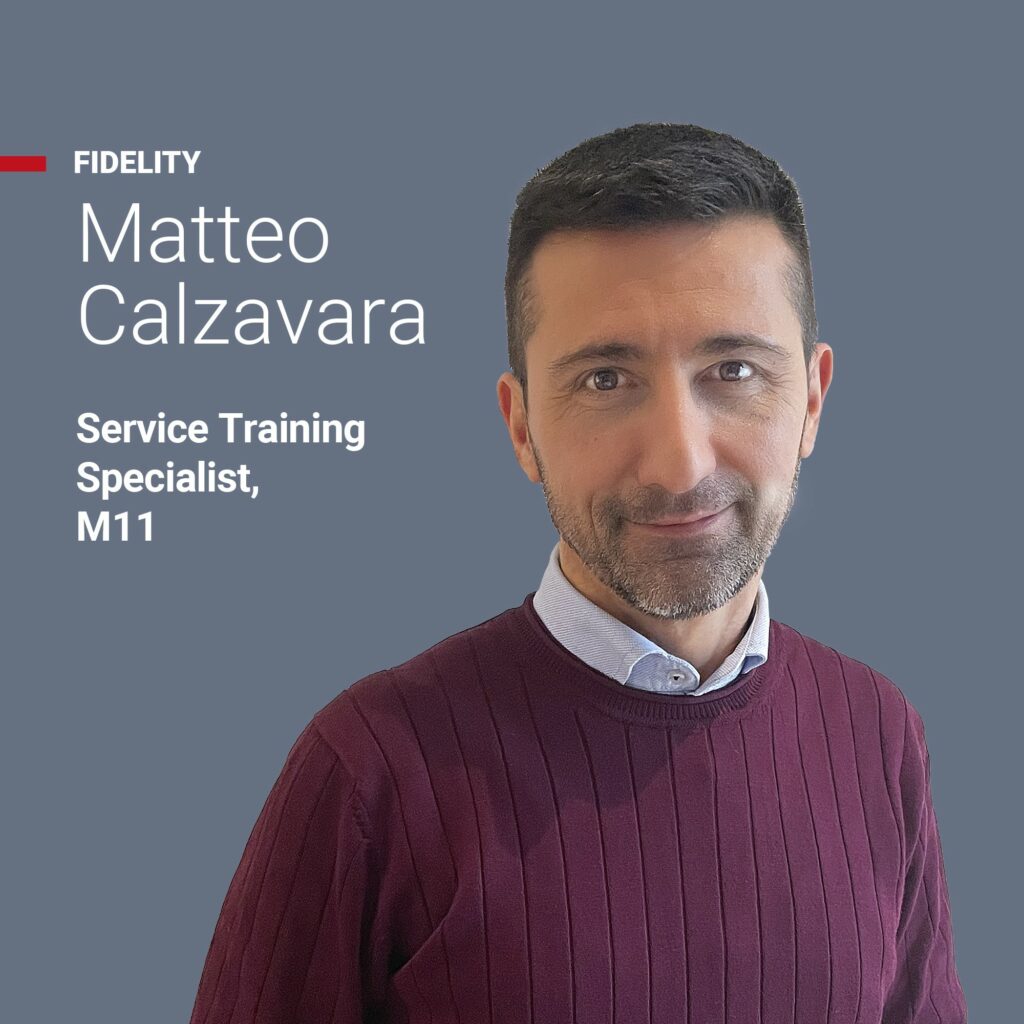
- You have survived three decades in here, what is your secret?
Gosh I confess to you that especially in these last two months I have been thinking about it several times and as a first reaction there has always been disbelief in realizing that these three decades have literally “flown by” . , it seemed like yesterday to me when I was “struggling” in Production Scheduling not to stop the lines in the absence of some component, then in Sales Planning where with the “crystal ball” one had to predict the following year’s Unit sales and so on, until the advent of Mitsubishi and the latest adventure in Service Business Development Dep. Well, all this is to say that there are no secrets of “resilience” but rather a set of factors that contributed to tie me to DeLonghi first and Climaveneta & MEHITS later: first of all, the working environment, security and Corporate stability were key factors, as well as the multiple opportunities for growth and stimuli that allowed me to change multiple assignments of increasing responsibility and satisfaction, while keeping personal motivation high. Last but not least, an always good relationship with colleagues and Managers with whom I was always able to collaborate in harmony and trust, in a Team with the same goals and in friendship both inside and outside the company… well, what more could you want!
- What is the most surprising thing you have learned about colleagues over the years?
Each colleague brings with them a unique set of skills, personalities and talents, regardless of age, experience, education or culture, whether they are newly arrived or corporately “older,” there is always so much to learn and share. That is why I have not one but dozens of amazing things I have learned about THEM during these years. Working with people with different backgrounds, values, principles, methods, languages, approaches to contingent issues, even cultures has given me new and incredible perspectives on problems (indeed, opportunities) and challenges. Wanting to condense it into a few words, I have learned that each of THEM possesses a wealth of knowledge, experience, and support that have enriched (and will continue to do so) not only my career, but also my personal life.
They are, pass me the term, small-big bricks that contribute to building the house of a person’s life.
- How have meetings changed over the years?
Here, this was perhaps an even more pronounced evolution for me, given the “wide window” of time in which I was a participant. Initially, “meetings” often took place in the middle of the production lines or with ‘raids’ on the office of the heads of the various departments with verbal exchanges and “close contacts,” there were no tools/software for organizing meetings but simple phone calls advising of the “visit” or meeting request (at best). Later, as the years went by, here is where meetings became more organized, they were planned with email, text or phone calls, with the creation of super excel or word tables to support them, but strictly in presence, they would grind kilometers or Miles (with Alitalia) just to see each other and discuss face to face with colleagues, customers and suppliers.
Then came somewhat more advanced and shared programming tools, but it was the advent of the Pandemic that was the watershed that revolutionized the way we do “meetings.” Since 2020 this world has changed, technological tools have evolved with such speed and efficiency that even in the present day, when COVID and interpersonal “contact” are no longer scary, they have overwhelmingly replaced Face-to-Face meeting options: if it is not strictly essential here are meetings being organized, processed and launched through increasingly structured and efficient software. Interactive meetings, video conferencing, with recording capabilities and a thousand other tools and options that maximize efficiency while also drastically reducing logistical costs and “dead” time, inevitable in face-to-face events. This trend, as indeed all interpersonal relationships, has thus to a large extent supplanted the healthy habit of meeting in person, interacting directly with the speaker(s), being able to confront/receive the physical messages they offer, thus limiting the people-to-people interactions that so characterized “our” beloved 90s-’00s-’10s.
0 Comments